Order publications and materials
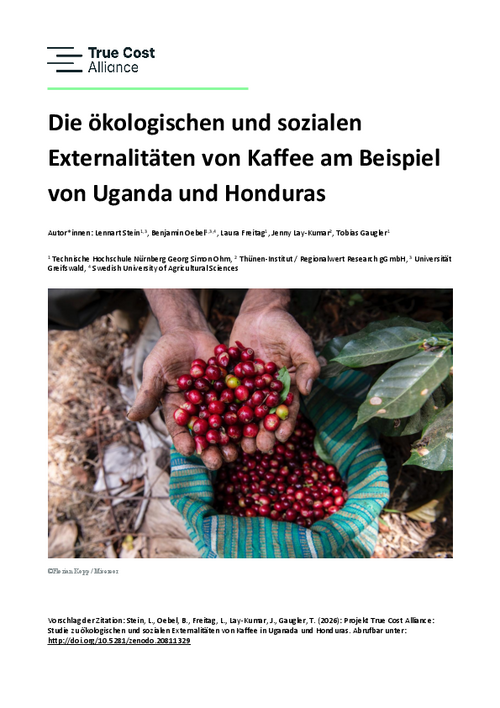
Study on the environmental and social externalities of coffee in Uganda and Honduras
The study highlights the hidden costs associated with coffee from Uganda and Honduras and suggests how these should be taken into account in companies’ financial statements. In addition to environmental impacts, social costs are also presented in detail for the first time.
- Publisher: True Cost Alliance in collaboration with Misereor, Nuremberg University of Applied Sciences, TMG – Thinktank for Sustainability
- Year of publication: 2026
Number of pages: 24 pages
French and Spanish translations available at misereor.org

Market power and its consequences: antitrust reform perspectives for agricultural supply chains
This study analyses the concentration trends in the food sector and develops proposals on how these can be curbed, particularly by means of antitrust law.
- Publisher: Rebalance Now e.V., Misereor e.V.
- Year of publication: 2026
- Number of pages: 52
This study analyses the concentration trends in the food sector and develops proposals on how these can be curbed, particularly by means of antitrust law.
- Publisher: Rebalance Now e.V., Misereor e.V.
- Year of publication: 2026
- Number of pages: 52

How does the Supply Chain Act work? Examples from practice
The joint report by Germanwatch and Misereor shows how the Supply Chain Act (LkSG), which has been in force since 2023, works in practice and is used by people around the world to defend their rights.
- Publisher: Germanwatch and Misereor
- Year of publication: 2026
- Pages: 16
The joint report by Germanwatch and Misereor shows how the Supply Chain Act (LkSG), which has been in force since 2023, works in practice and is used by people around the world to defend their rights.
- Publisher: Germanwatch and Misereor
- Year of publication: 2026
- Pages: 16

Briefing Right-wing alliance against sustainability?
In a joint briefing, Global Policy Forum Europe, Misereor and the Supply Chain Law Initiative warn against the European People's Party (EPP) cooperating with far-right political groups to reverse the EU Supply Chain Directive. The background to this is the European Parliament's upcoming position on the European Commission's so-called omnibus proposal to "simplify" the EU's sustainability rules.
- Publisher: Global Policy Forum Europe, Misereor, Supply Chain Law Initiative
- Year of publication: October 2025
- Pages: 8

Two years of the Supply Chain Act - A field report
Why a strong supply chain law is needed and how it can be effectively implemented.
- Publisher: ECCHR, Bread for the World, Misereor
- Year of publication: May 2025
- Pages: 56
Why a strong supply chain law is needed and how it can be effectively implemented.
- Publisher: ECCHR, Bread for the World, Misereor
- Year of publication: May 2025
- Pages: 56

Briefing: Rollback of the European Green Deal? Omnibus Regulation threatens to undermine EU Supply Chain Directive
A briefing by the Supply Chain Act Initiative
- Publisher: Initiative Lieferkettengesetz, Author: Armin Paasch
- Year of publication: February 2025
- Pages: 8
A briefing by the Supply Chain Act Initiative
- Publisher: Initiative Lieferkettengesetz, Author: Armin Paasch
- Year of publication: February 2025
- Pages: 8

The problematic coal imports of German energy companies
Energy suppliers in Germany continue to use large quantities of hard coal from countries where the human rights situation in the mining areas is poor. They are now seeking dialogue with those affected locally. However, mine operators still do not have to fear any consequences.
- Publisher: Misereor
- Year of publication: 2017
- Pages: 4

Sustainable on paper only
The ambivalent role of business in implementing the SDGs
More and more companies are publicly committing to implementing the 2030 Agenda and referring to the Sustainable Development Goals (SDGs) in their sustainability reports. However, their corporate practice often looks different: Time and again, those affected complain about human rights violations and environmental pollution along the supply chain of transnational companies. The implementation process of the 2030 Agenda is seen by a growing number of economic actors as a welcome opportunity to counter this criticism, shape the discourse in their favour and influence political decisions accordingly.
- Publisher: Misereor, Global Policy Forum, Bread for the World,
- Year of publication: 2019
- Pages: 8
The associated working paper "Lack of rules of engagement with business is a major risk for the UN and the 2030 Agenda" can be found here: publication-rules-of-engagement-un-private-actors.pdf (misereor.de)

The security business
TÜV SÜD's role in the Brumadinho dam collapse in Brazil
At least 272 people were killed when the B1 dam near Brumadinho (Brazil) on the site of the Córrego do Feijão iron ore mine collapsed on 25 January 2019. 21 people who died when the dam burst have not yet been found. The wave of mud destroyed buildings and contaminated fertile soil as well as large parts of the Paraopeba River, which supplies the region with drinking water.
- Published by: ECCHR and Misereor
- October 2019
- Pages: 4

More and better development financing
What can the Fourth International Conference on Financing for Development achieve?
The Fourth International Conference on Financing for Development (FfD4) will take place in Seville in June 2025. The briefing briefly describes the key challenges of the FfD process and presents political options for action.
- Publisher: Bread for the World, Global Policy Forum Europe and Misereor
- Pages: 12
- Year of publication: January 2025
We will be happy to answer your questions about ordering materials on 0241/442-945 or by e-mail at bestellung@misereor.de.

Alexandra Mielczarek
Orders
- Telephone
- +49 241 442945
- bestellung@misereor.de
Research in the literature database of the Misereor library
Would you like to find out more, or are you conducting research for a dissertation or final-year project?
The Misereor Library is an in-house specialist library focusing on development cooperation and development policy, with a particular emphasis on the Church’s development work; however, it is open to external users by prior appointment.
The library’s collection can be searched via the online catalogue. Books cannot be borrowed and there is no photocopying service available.

Bettina Schaper
Information and Knowledge Management
- Midoc@misereor.de