Protection for refugees and displaced persons
Being a refugee means taking only the bare essentials with you. It means surviving on the streets, in emergency shelters, in tent camps. It means not knowing what will be tomorrow, the day after or in one year's time. Being a refugee is life-threatening.
Refugees and displaced persons need more protection and humane and dignified responses. The Geneva Refugee Convention was developed and adopted after the Second World War due to the dramatic situation of refugees and displaced persons, with a focus on Europe. Today, Europe is curtailing the rights and protection of refugees, thereby jeopardising the Geneva Refugee Convention.
Misereor's support for refugees
Our partner organisations support refugees with many different measures:
- In the short term, our partners provide emergency aid and distribute food, medicines, blankets and hygiene products.
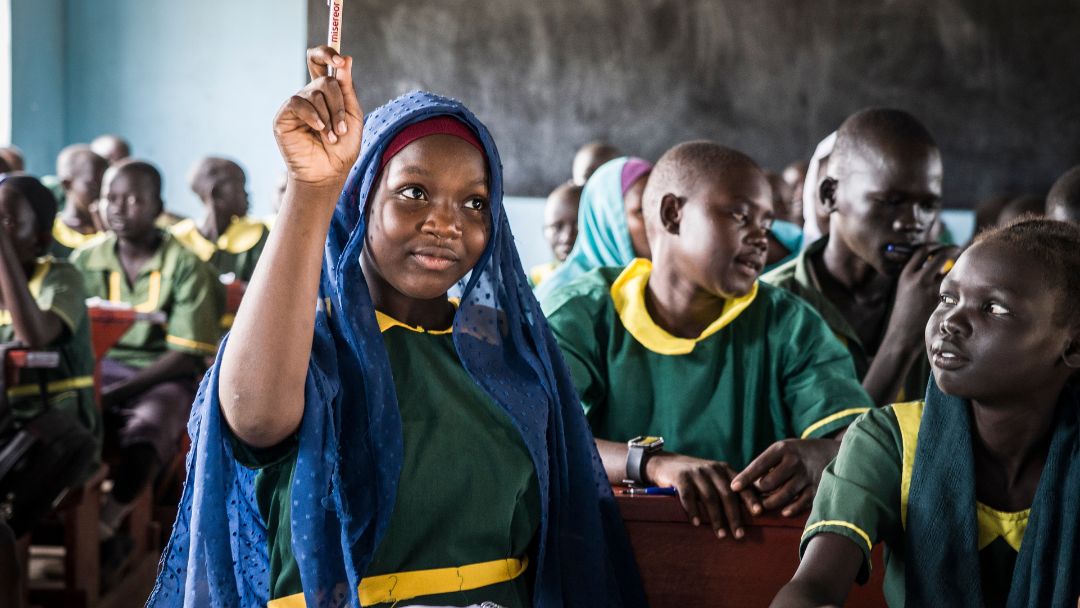
- Children and young people are supported to continue their education, even under difficult conditions. Girls and young women are given special support.
- Long-term prospects are also important - in the new or old home. Education and training are immensely important for refugees.
- Fear is a constant companion for many refugees. Traumatised people are offered psychosocial support.
- Encounters support reconciliation work and peaceful coexistence between refugees and host communities.
- Misereor helps people where they are: most of the funds for refugees are used to support people in the conflict and crisis areas in Syria and its neighbouring countries. However, the work also focuses on South Sudan, Cameroon, Mozambique, South Africa, Myanmar and Colombia.
Most refugees and migrants are still displaced within their home regions or are searching protection in their own country. We support them through local partner organisations in a variety of ways in their regions of origin and along their escape routes.
Where Misereor supports refugees and migrants
Misereor works worldwide to protect refugees and migrants – from emergency aid and psychosocial support to education, integration and long-term prospects for the future. Partner organisations not only provide humanitarian aid but also strengthen social cohesion and the rights of refugees to promote peaceful coexistence with host communities.
- In Africa , the focus is particularly on resilience, livelihood security and social integration – for example, through vocational training and income-generating opportunities for refugees, as in the case of Mauritania, where targeted career prospects are being created for migrants.
- In Latin America and the Caribbean, the focus is on protecting vulnerable groups and strengthening human rights – for example in Haiti, where projects promote the protection of children at risk as well as support for displaced persons and returnees in crisis situations.
- In South-West Asia and North Africa ( SWANA), Misereor concentrates primarily on providing for refugees in protracted crises, as well as access to education, health services and psychosocial support – for example in Lebanon, where refugees are supported through educational programmes and social services.
- In the Asia-Pacific region, Misereor supports in particular access to rights, education and livelihoods, as well as the resilience of those affected by climate change, conflict and crises – for example in Myanmar or along the Thai border, where refugees are empowered legally, socially and economically.

Mariana Ghawaly Giacaman
Policy Officer
- Telephone
- +49 30 4435198391
- mariana.ghawalygiacaman@misereor.de



Safe return? What Syria's categorisation as a safe country of origin would mean
How does the categorisation as a "safe country of origin" shape asylum policy and what impact does…
How does the categorisation as a "safe country of origin" shape asylum policy and what impact does it have on Syria? This policy paper analyses the legal basis and risks and questions key asylum policy standards.
- Number of pages: 11
- Publisher: Misereor
- Year of publication: 2025
How does the categorisation as a "safe country of origin" shape asylum policy and what impact does it have on Syria? This policy paper analyses the legal basis and risks and questions key asylum policy standards.
- Number of pages: 11
- Publisher: Misereor
- Year of publication: 2025

Monitoring EU externalisation policy - Bulletin 05
Every two months, Statewatch and migration-control.info publish a bulletin in which the most…
Every two months, Statewatch and migration-control.info publish a bulletin in which the most important documents and minutes of relevant EU working groups are compiled and analysed. The aim is to provide the general public with an overview of current and planned measures in the field of externalising European migration policy. The information collected can serve as a basis for legal, campaigning and advocacy work by civil society, journalistic research and scrutiny by national and European parliamentarians.
- Publisher: Statewatch & migration-control.info
- Number of pages: 16
- Year of publication: February 2025
- Further bulletins at www.statewatch.org/outsourcing-borders-monitoring-eu-externalisation-policy

Country dossier on the EU migration partnership with Egypt
Country brief
The migration partnership between Egypt and the EU has gained new momentum thanks to…
Country brief
The migration partnership between Egypt and the EU has gained new momentum thanks to the most recent agreement on March 17. The background to this is the EU's concern about an increase in irregular arrivals, which is putting previous cooperation in the externalisation of European asylum responsibility to the test. How will the partnership be implemented in practice? What impact does it have on migrants, refugees and the partner country? These questions are answered in the current country brief by Misereor and Brot für die Welt on the EU migration partnership with Egypt. (The German version will follow shortly)


