DR Congo: Solar power for hospitals
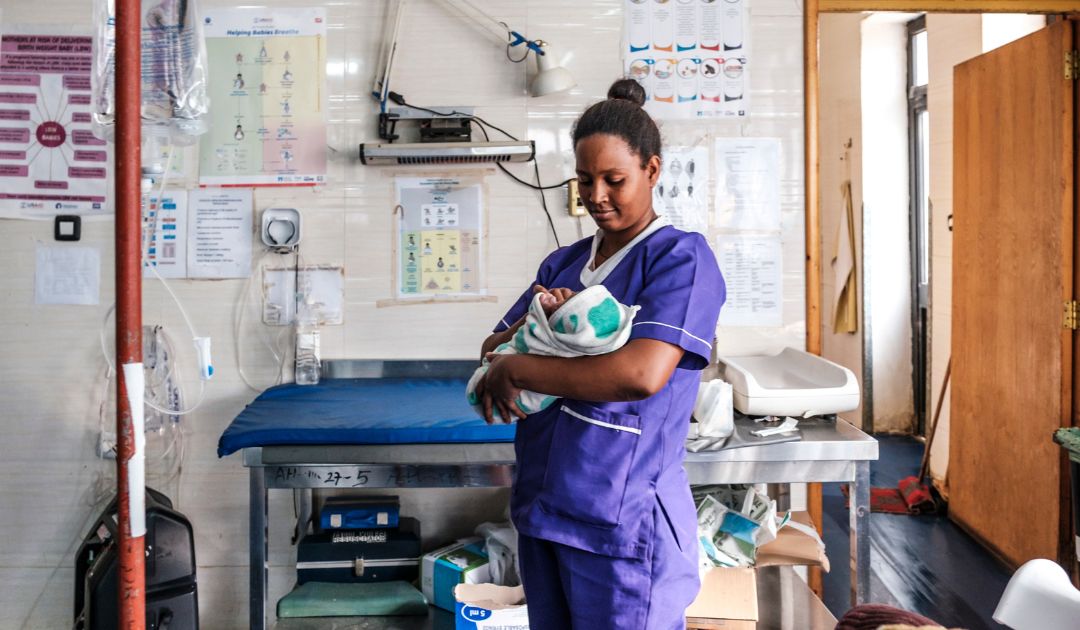
Solar power saves lives: in Boma, solar power systems ensure safe births, refrigerated medicines and round-the-clock medical care. This is by no means a given!
With your donation, you’ll help strengthen reliable local energy and healthcare provision and support Misereor’s work around the world.
- Africa

Challenges in the healthcare system
For decades, the Democratic Republic of the Congo has been plagued by poverty and recurring conflicts. Women and children are particularly affected. In many regions, there is a lack of stable basic services: diseases spread rapidly due to poor hygiene, and maternal mortality remains high. Without electricity, reliable medical care is often impossible – vital equipment fails, and even routine procedures become risky in the dark.
Clean energy for safe births
The Bureau Diocésain des Œuvres Médicales (BDOM) in the Diocese of Boma is working with great dedication to stabilise medical care. Thanks to the expansion of solar energy, 28 out of 33 health centres now have a reliable, sustainable energy supply. The treatment rooms are well lit, blood reserves and vaccines remain chilled, births can be safely attended, and medical staff can care for patients at any time – even at night.
Lasting effect for many years
Solar power makes the facilities independent of expensive and unreliable diesel generators. This saves on running costs, protects the climate and provides planning certainty. The on-site team receives targeted training in the operation and maintenance of the equipment. The fuel costs saved go directly towards medicines and the treatment of patients who would otherwise be unable to afford care.
Clean water saves lives
As well as the electricity supply, access to clean drinking water is a crucial factor: newly installed deep wells at the stations have led to a significant reduction in cases of diarrhoea and infectious diseases.
Here’s what our local partners have already achieved:
- Nine healthcare facilities in the Diocese of Boma have been fitted with new solar power systems.
- Twenty-eight health centres are now permanently supplied with environmentally friendly electricity.
- Two health centres have, for the first time, been given direct access to clean drinking water via boreholes.
- 425 destitute patients were able to receive free medical care.
Would you like to find out more about our charity projects? Then read our magazine “Weiter.wirken” now. The magazine about and for the people who make a difference at Misereor.
When making a donation by bank transfer, please state the reference ‘S63109/Congo Solar Energy’ in the payment details. This lets us know which project is particularly close to your heart; your contribution will be channelled as a general donation towards this work and Misereor’s overall global mission.
To ensure that your donation has an impact in the long term, Misereor uses a small proportion for important administration an related tasks. This way, we make sure that projects are selected carefully and implemented responsibly and that their effects are regularly monitored. Should it not be possible to use your donation as planned, we will use it where it is currently needed most.
Our local partner organisations
Congolese Caritas
Misereor has been supporting health projects run by Congolese Caritas for decades. Caritas has set up a network of health centres to provide medical care to poor people in the various regions of this huge country. The health centres are run by nurses who are able to treat the most common diseases locally and attend normal births.
Father Piumatti
In Kanyabayonga, the people are supported by Father Piumatti, an experienced Misereor partner who has already implemented several projects of this kind.

Mona Plate
Donor Communications
- Telephone
- +49 241 442518
- mona.plate@misereor.de
Share this page