Order publications and materials

WorldRiskReport 2025
The report highlights the connection between extreme natural events and social factors such as economic stability, healthcare and good governance. The report also contains the WorldRiskIndex, which indicates the disaster risk for 193 countries worldwide.
- Publisher: Bündnis Entwicklung hilft
- Year of publication: September 2025
- Pages: 74

Position paper: Climate-friendly construction
Based on the many years of experience of Misereor and its partner organisations, the position paper "Climate-friendly construction" formulates principles for the promotion of projects in the construction sector. These are intended to serve as guidelines for project work and at the same time initiate a constructive dialogue with decision-makers in politics and the construction industry.
New housing developments and rapidly growing cities are causing the demand for living space and infrastructure to rise sharply. Building is therefore often necessary. Misereor has been supporting construction projects for many years. However, building always means interfering with existing ecological systems because it consumes energy, resources and land. All building projects supported by Misereor must fulfil certain quality criteria: In addition to compliance with building regulations and fire safety rules, context-specific and climatic conditions as well as climate and environmental protection requirements, socio-economic compatibility and cultural aspects must be taken into account when designing and constructing buildings. This position paper sets out Misereor's principles for climate-friendly construction.
- Publisher: Misereor
- Publication date: August 2019
- Pages: 12
- Soon also available to order as a print version

Climate policy in cities without displacement
Conference report on the international symposium on 31 May 2016 in Berlin in preparation for the 3rd UN World Summit on Housing and Sustainable Urban Development (Habitat III).
The summit, which will take place in Quito, Ecuador, from 17 to 20 October 2016, is intended to concretise the implementation of the Sustainable Development Goals for the urban sector. The challenges posed by climate change play a special role here. Cities emit around 75% of greenhouse gases and consume two thirds of the world's energy. The aim of the Habitat Conference is to develop a new model for sustainable urban development, the "New Urban Agenda". At a symposium, Misereor asked how the rights of poor people can be taken into account and displacement prevented within this framework of necessary climate change adaptation, climate protection and strengthening resilience. The urban poor are severely affected by the consequences of climate change and the impact of investments in climate change mitigation and adaptation. Their settlements are often located in danger zones, on riverbanks, by the sea, on roads, on steep slopes, in flood plains or under power pylons.
- Publisher: Misereor
- Year of publication: 2016
- Pages: 4
Climate policy in cities without displacement
In favour of anchoring human rights principles in the urban agenda. A Misereor position paper on the 3rd UN World Summit on Housing and Sustainable Urban Development (Habitat III).
- Published by: Misereor
- May 2016
- Pages: 8
In favour of anchoring human rights principles in the urban agenda. A Misereor position paper on the 3rd UN World Summit on Housing and Sustainable Urban Development (Habitat III).
- Published by: Misereor
- May 2016
- Pages: 8

Incitement to save the world. One year of the encyclical Laudato si'
Pope Francis' letter "Laudato si'" has been causing a stir since 2016. Francis' proposals are being discussed favourably around the world. We explain them with reference to the topics of climate, nutrition and urban development.
- Authors: Markus Büker (theology), Stefan Tuschen (climate), Anja Mertineit (nutrition), Almuth Schauber (city)
- Publisher: Misereor
- Year of publication: June 2016
- Pages: 16

Urban dreams - The city of tomorrow - ecologically and socially just
- Secondary level I
- Geography
Urban settlements only cover around two per cent of the earth's surface, yet more than half of the world's population has been living in cities since 2008. By 2050, the United Nations estimates that this figure will rise to two thirds of all people. This rapid growth poses enormous ecological and social challenges for large cities and urban centres, especially in the Global South.
This "Urban dreams" material set addresses the questions "What can the "city of the future" look like?" and "How can urban structures be designed to be socially just, inclusive and sustainable - worldwide?". The set consists of the teaching material "A World of Cities", which takes a closer look at various aspects of the topic, and the suggestions for the project week "Design your city".
Individual materials for lessons or the project week can be downloaded separately: To the ZIP file.
- Publisher: Misereor
- Number of pages: 76
- Year of publication: 2023
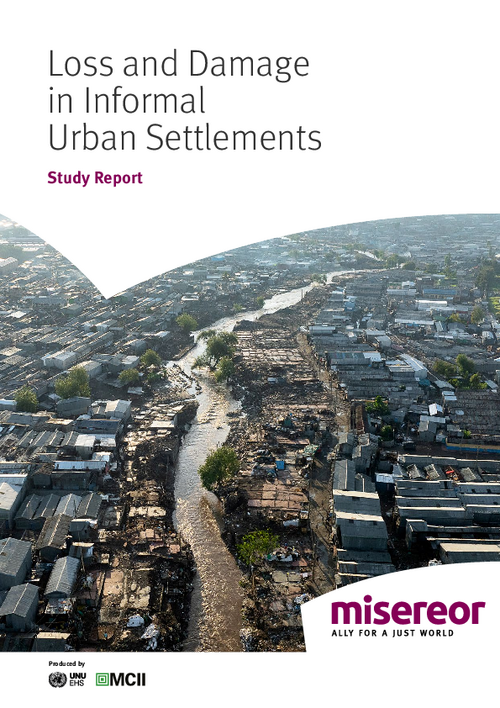
Loss and Damage in Informal Urban Settlements
Despite adaptation efforts, climate-related disasters are increasingly affecting vulnerable urban communities. Using case studies from Sao Paulo (Brazil), Nairobi (Kenya) and Jakarta (Indonesia), the research summary commissioned by Misereor and conducted by UNU-EHS and MCII analyses how vulnerability, exposure and climate-related hazards cause economic and non-economic loss and damage in urban informal settlements. It identifies strategies to avert, minimise and cope with loss and damage, and outlines how financing mechanisms should be designed to ensure adequate support for the most climate-vulnerable urban communities.
Publisher: Misereor
Year of publication: October 2024
Number of pages: 137

Mobility for all: utilising opportunities - shaping the future
This paper takes a global look at the issue of mobility and calls for a change in favour of the poorest population groups in the Global South.
After all, a mobility transition is the core element of the global socio-ecological transformation that enables a good life for all while respecting our planetary boundaries. The positive effects of the mobility transition can be achieved in particular if mobility is designed to be accessible, respects human rights and effectively recognises the interactions within the climate crisis.
- Publisher: Misereor
- Year of publication: February 2023
- Pages: 12

Position paper on cities as a lever for socio-ecological transformation
The world is becoming increasingly urbanised. By 2050, two thirds of the world's population will probably live in cities. However, cities are particularly affected by the consequences of climate change. Inclusive, human rights-based and climate and environmentally friendly urban design can have a major "leverage effect" for socio-ecological transformation.
- Publisher: Misereor
- Year of publication: May 2024
- Number of pages: 37
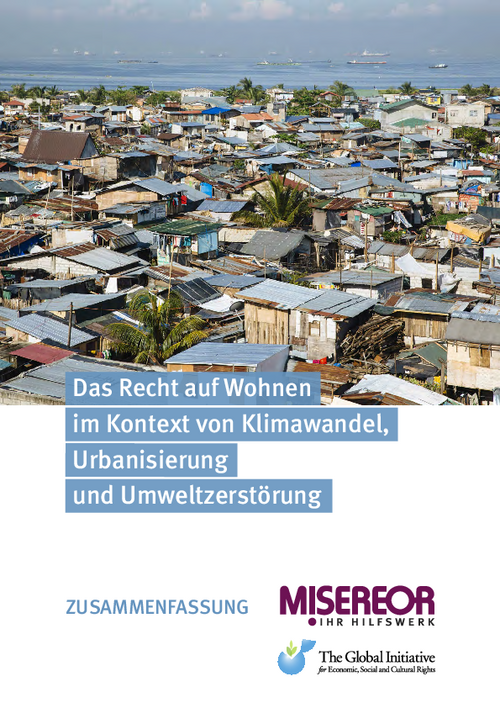
The right to housing in the context of climate change, urbanisation and environmental degradation - Summary
The report shows how the right to housing and related human rights are increasingly threatened by climate change, urbanisation and environmental degradation and presents local experiences from Africa, Asia and Latin America. It calls for a coherent approach to policy-making. In six reports from five countries (Cameroon, El Salvador, Nigeria, Peru and the Philippines), civil society organisations demonstrate community-based solutions. The report concludes with recommendations to national and local governments and the United Nations human rights bodies.
The full report is available in English. Summaries are available in English, Spanish and French.
- Publisher: Misereor
- Year of publication 2020
- Pages: 8
We will be happy to answer your questions about ordering materials on 0241/442-945 or by e-mail at bestellung@misereor.de.

Alexandra Mielczarek
Orders
- Telephone
- +49 241 442945
- bestellung@misereor.de
Research in the literature database of the Misereor library
Would you like to find out more, or are you conducting research for a dissertation or final-year project?
The Misereor Library is an in-house specialist library focusing on development cooperation and development policy, with a particular emphasis on the Church’s development work; however, it is open to external users by prior appointment.
The library’s collection can be searched via the online catalogue. Books cannot be borrowed and there is no photocopying service available.

Bettina Schaper
Information and Knowledge Management
- Midoc@misereor.de